
The King Bird-of-Paradise (Cicinnurus regius) is one of nature’s most vivid birds, belonging to the bird-of-paradise family, Paradisaeidae.
If you prefer not to read the full story,
Skip ahead to watch the video ->
Recognized by the International Ornithological Congress (IOC) as the only member of the Cicinnurus genus, it is closely related to Diphyllodes, which some taxonomists consider part of the same genus.
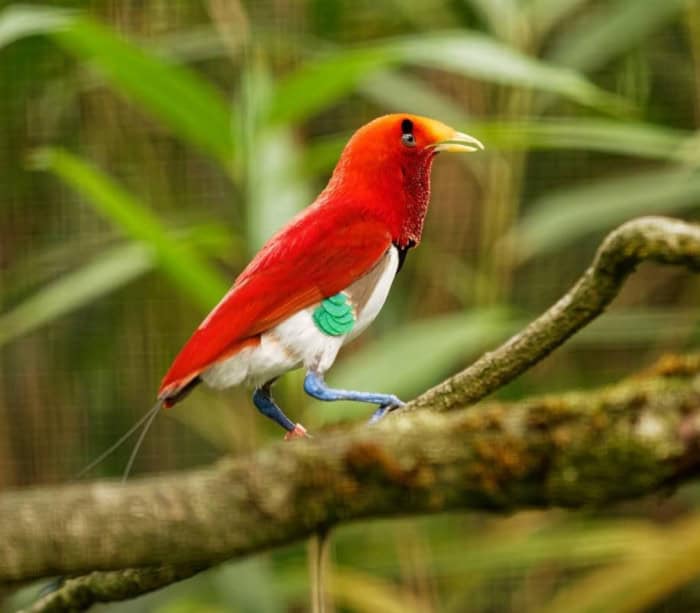
Widely distributed across the lowland forests of New Guinea and neighboring islands, including Aru, Salawati, Misool, and Yapen, the King Bird-of-Paradise primarily inhabits lowland rainforests, gallery forests, and forest edges.
It can sometimes be found at higher altitudes in the hills and lower mountain regions, though these populations remain less studied.
Characteristics and Appearance
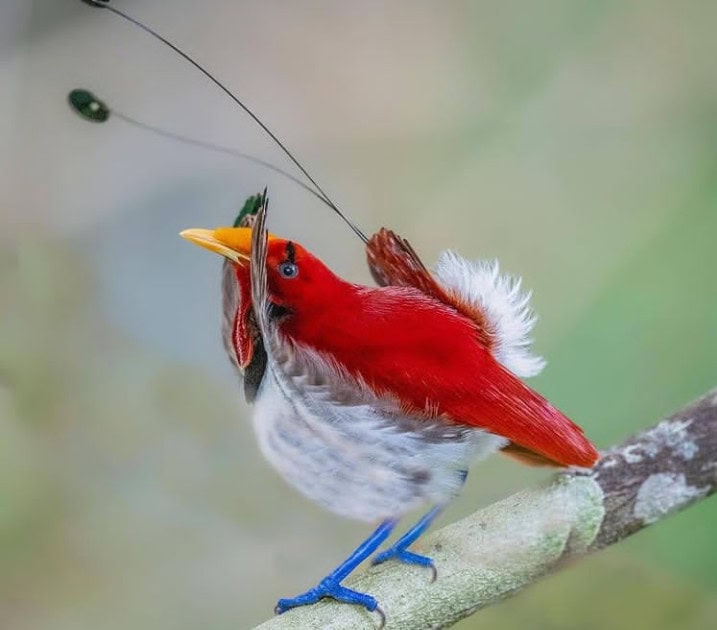
Known as a “living gem,” the King Bird-of-Paradise is the smallest and most vibrantly colored among its relatives. Males reach about 6.3 to 7.5 inches (16–19 cm) in body length or 12.2 inches (31 cm), including the central tail feathers.
Females weigh between 0.08 and 0.13 pounds (36–59 g), while males weigh slightly more, between 0.10 and 0.14 pounds (45–64 g).
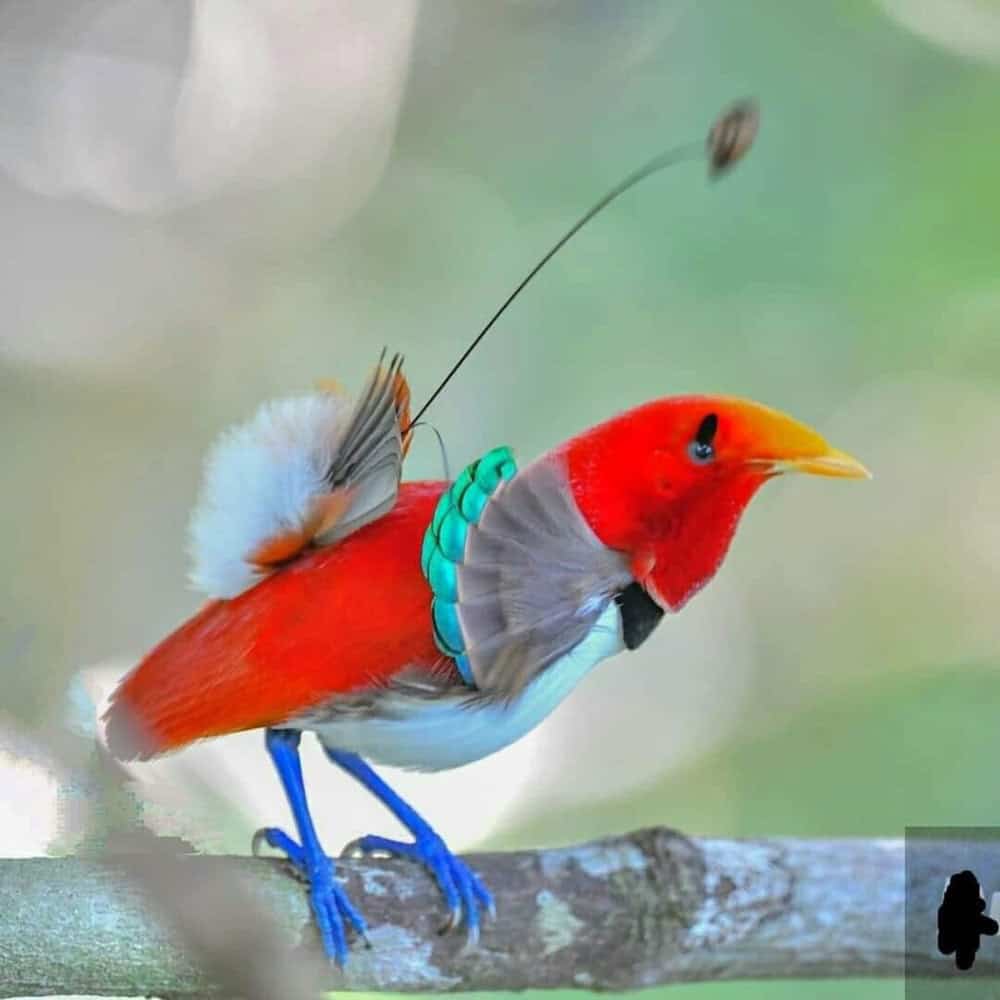
Adult males display a metallic crimson hue, sometimes orange, under certain lighting, particularly on the crown. Their narrow, dark green breast band contrasts with the white lower breast, while shoulder feathers boast green-tipped fan-like shapes.
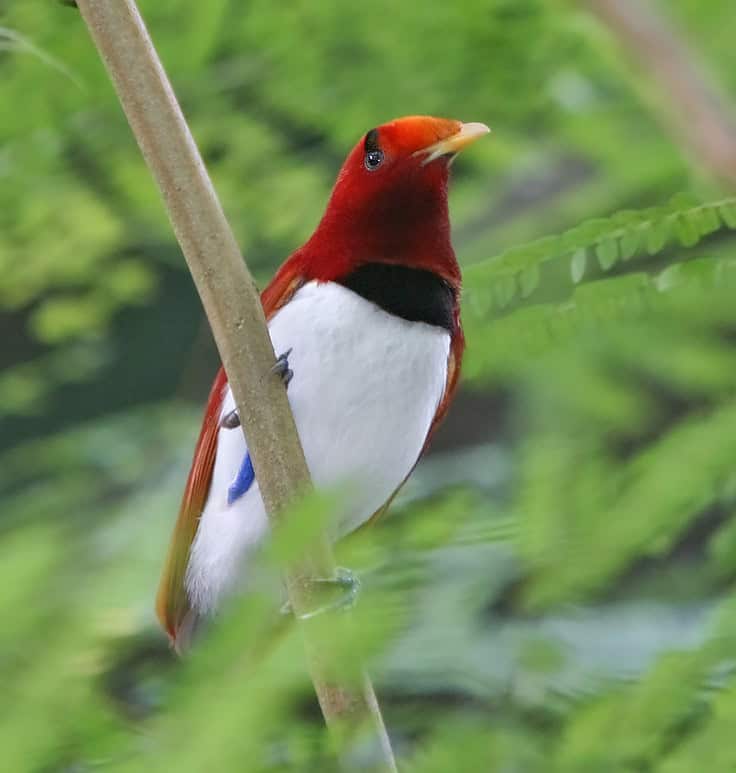
They have ivory-yellow bills and violet legs. Females, in contrast, are more subdued, with olive heads and upper parts, yellowish underparts, and violet legs.
Habitat and Distribution
The King Bird-of-Paradise occupies a broad range in New Guinea and surrounding islands, favoring lowland rainforests, gallery forests, and disturbed or tall secondary forests. Its presence across various forest levels, including mixed-species foraging groups, allows it to thrive in its complex habitat.
Unique Courtship and Breeding
These birds practice polygyny, with males performing solo displays at exploded leks and sometimes in small groups at traditional arboreal display areas.
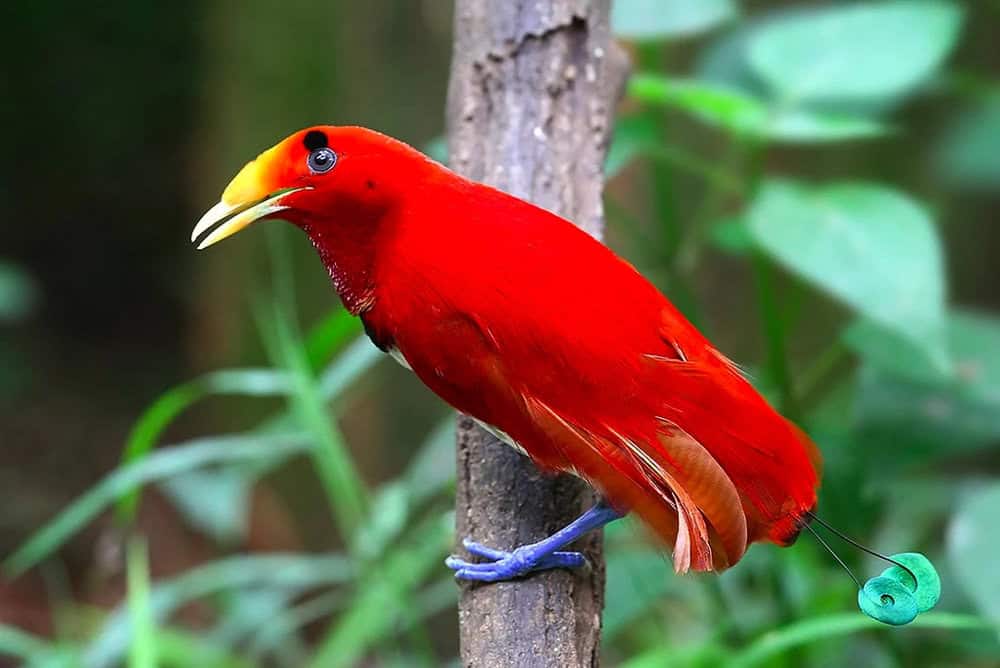
Known for their persistent calls, King Birds-of-Paradise incorporates vocalizations, feather displays, and diverse body posturing in their courtship, including hanging upside down and swinging like a pendulum.
Their displays include tail swinging, fluffing white abdominal feathers to resemble a cotton ball, and acrobatic movements using their long tail feathers.
Breeding generally occurs from March to October. Females build open-cup nests in tree cavities—a unique feature among bird-of-paradise species—and lay two eggs.
They alone tend to the nest and care for the young. In captivity, incubation lasts around 17 days, with the nestling period extending about 14 days.
Diet and Feeding Behavior
King Birds-of-Paradise feed primarily on fruits and arthropods, foraging across various forest levels. They often join mixed-species flocks to seek insects and other invertebrates in the lower forest canopy.
Conservation Status
Though habitat loss and hunting pose threats, the King Bird-of-Paradise remains widespread and abundant. The International Union for Conservation of Nature (IUCN) lists it as “Least Concern” on the Red List of Threatened Species.
However, continued conservation efforts are essential, as the species is also included in Appendix II of CITES, indicating that it could become threatened if not monitored.